Got some pictures of vardo plans for everyone today! Aren't they neat? Lars drew them up for us a week or two ago.
Since the door of the vardo is going to be over the trailer tongue, a section of the railing is going to be cut out to accommodate it. Then, the plan is to have a little porch over the trailer tongue(possibly that folds upward against the front wall for travel). The advantage to this is that I won't have to try and camouflage the trailer tongue at events; it will already be hidden under the front porch step.
Thoughts on Money and Goals
One of the best things that I've learned while putting together this project is how to set a goal and budget for it. Now, I have never been very good with my money. (Weird, considering I'm an ex-head bank teller.But oddly, my money and the bank's money were two different things in my mind, and not to be treated in the same way.) I couldn't ever get a handle on it. I was constantly overdrawing myself and the bank was constantly raping me for overdraft fees.
Let me tell you how I despise banks; having worked for one in the past, I was well aware that you must always ask yourself 'how is this bank making money off of me?' Even when the checking account is 'free', even when they're giving away free toasters, credit cards, T-shirts or super fabulous car-loans, you must always remind yourself that they would NOT be doing that if they weren't making money off of you hand-over-fist somehow. Cherchez la FEE, people.
In any case, even knowing all this, I still allowed them to regularly help themselves to the money in my checking account with a big shovel due to my own stupidity and unwillingness to sort through the mess that I'd made. Well, this project changed all that.
To begin with, I realized sometime in January I could never have this vardo if I didn't bite the bullet and get my act together. And, even though Pennsic as seen from January seems forever-and-a-day away, I also knew that paychecks come and go with frightening speed and that I'd better get my act together toute suite if I wanted to do this thing. So with a motivation that was finally big enough, I finally sat down and began figuring out how much I would need for all my expenses. At the same time, I began to obsessively start paying off past-due stuff, so that I could be all caught up.
And what do you know? It worked. Not only have I been able to set aside the money necessary to realize my dream, I also have reached a point where I haven't paid an overdraft fee since the end of January. By my calculations, that means that I've saved myself somewhere in the realm of $500. (I'm NOT kidding - in fact I may even be underestimating. I was the kind of person who'd forget the latte she got 3 days ago and get hit with $25 because it overdrew my account. That means I was paying something like $28 for a friggin' cuppa coffee.)
Now, I'm addicted to KNOWING how much I have. It's so wonderful to be able to be free of worrying if I have enough for groceries or gas. I know I do. I may not have money that day for anything else, I may have to wait until payday to buy that cute blouse, but that awful uncertain worry is gone. I even hazard to say that I'll never let things get so messed up again that I have to feel that way ever again.
As an interesting side effect to this whole budgeting thing, I've been cooking a lot more (as opposed to eating out), and trying new recipes. And what do you know? They've been coming out really good. Norm feels better, digestion-wise, and Ian loves my cooking. We've also made our meals healthier, so next step for me is tweaking the cooking habit to maybe help us all lose weight and feel better too.
So, the lesson for today is, if you want to get a habit of good financial management, I say, set a goal of something you really, really want badly. It will get you the motivation you need to build the habit. Once you're used to budgeting, and it's ingrained in you good and firmly, then you can do something you should do like save for retirement. If you do it the other way round, I have to wonder if it's enough incentive to really be good. It wasn't enough for me.
Saturday, May 14, 2011
Sunday, May 8, 2011
Fun With Windows
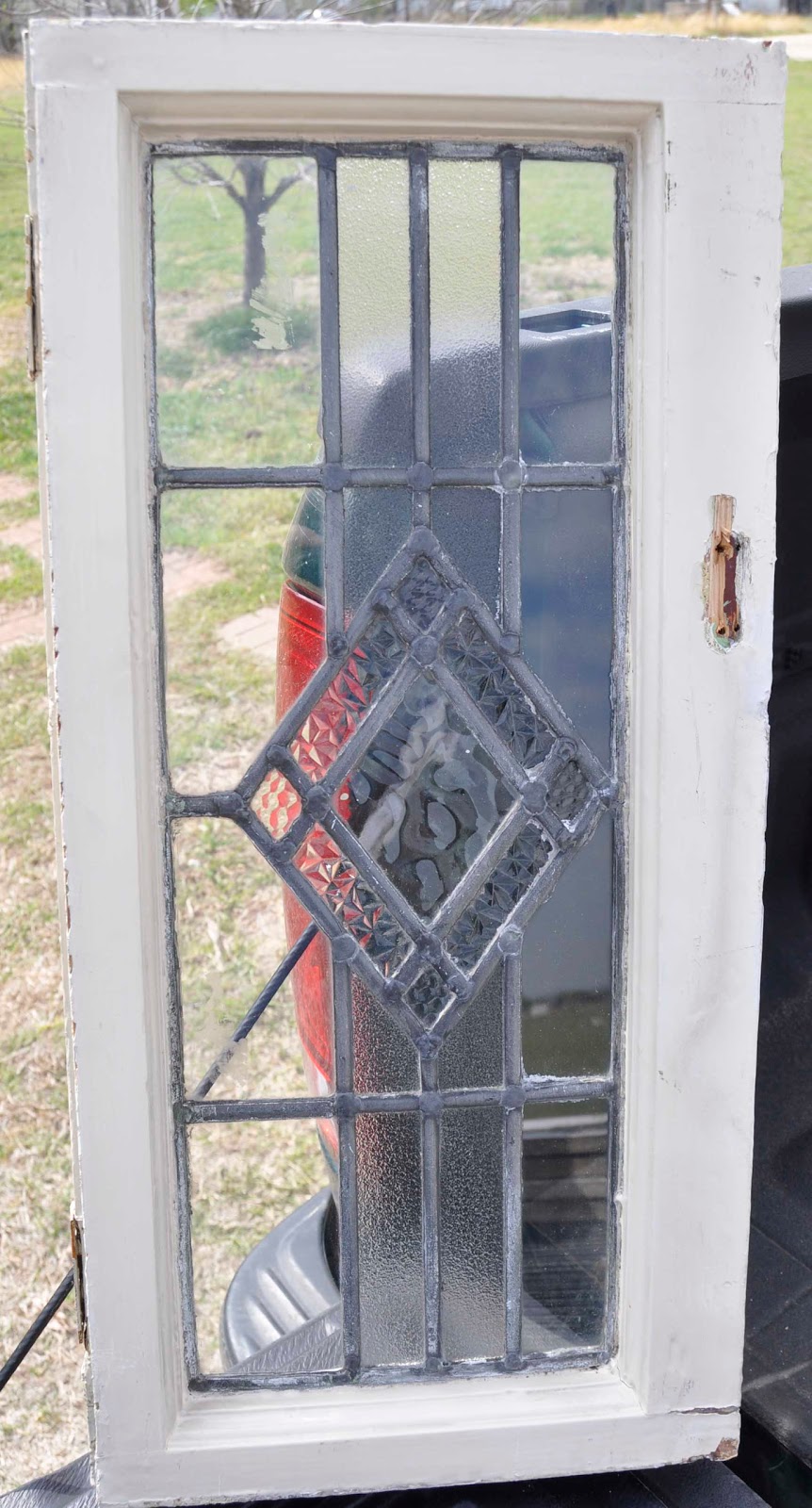
Don't'cha just love Ebay? Where else could you find four (count 'em FOUR) British leaded casement windows for $300?
Mind you, I saw plenty of stained glass windows on Ebay, Craigslist, and at local antique places, but a lot of them are incredibly expensive, or else the condition is poor. But these were beautiful and the price was fantastic.
I got two each of this style:
And two each of this style:
Plus this one, which will go in the back of the vardo, over the bed. This one cost $60:
Of course, I didn't want them painted white, so we had to strip 'em. Gads, what a messy job. The interior molding had to be stripped with paint-stripping-goop. By the time I was done with that, I was hot, sweaty, and stinky with paint-thinner. Here is what the windows looked like once I'd done the chemical strip:
There were about four layers of paint on these; white, yellow, green, and white again, and underneath it all, at one time they had originally been stained.
Once I had stripped the molding on the inside, Norm was able to do the flat sides with a sander.
At this point, we realized that the old glazing was falling out in chunks. So, we decided that the glazing should be chiseled out and re-done. We decided to use a more modern material for this, the silicone putty used in modern houses. It's more flexible and would withstand moisture better. Naturally, once the windows had been removed from their frames, we saw that the leading needed repair. Norm tried to do some work on them but he didn't have the right type of equipment. Here's a picture of him working on the windows:
We were very fortunate that we have in Newton a really great stained glass studio, the kind that restores church windows and such: Northeast Stained Glass. The people there were really nice; they soldered the weak spots in the edging for $20 for each window. (We didn't have to repair every one: we got away with doing 3 out of 5.)
Interestingly, the guy at the stained glass place told me that in order to make these windows from scratch it would have cost $1000. (Not sure if he meant $1000 each or $1000 for the two that he happened to be examining at the time.) But still. A pretty damn good deal, if I do say so myself.
As I mentioned, we used a more modern silicone caulk to seal the windows once they'd been nailed in and made secure. Here's a detail picture of the caulking (it already came in brown, we don't even need to paint it):
Once we had re-glazed the windows (or rather, once Norm re-glazed them), it was time for touch up paint, then stain. The touch-up involved covering any recesses that still had white paint in them with brown paint, so that when they were stained it would blend. The painted bits (nail holes, divots and such) just end up looking like a natural blemish in the wood, which is fine if you like the antique look (which I do.) Lemme tell you, the staining is the easy part! Dip a rag, wipe it on, and ta-da! Here's the windows all nicely stained. What a difference, yes?
All that remains is to put a coat of satin spar-urethane on them. As of this writing, they need to sit for another day or two to dry out a bit more. But I am so pleased with how they came out!
So pleased, in fact, that halfway through all of this effort (about a month's worth of effort, in fact) I realized we'd better make some shutters to put over them for traveling, winter storage, etc. I do NOT want all of our hard work to be done in by a rock from a dump truck or something. We already have an idea how we're going to do the shutters. Probably plywood with two drawer-handles on to make it easy to place them, and maybe window-sash latches to keep them secure. I'll even stain and seal them so they look nice and last awhile.
The next installment won't be so long in coming, and the subject will be:
The Best Laid Plans
Ta, all!
Friday, April 1, 2011
The Trailer Gods Smile
You can't have a gypsy wagon without the wagon part.
So my first order of business was to get a trailer to build on. This presented a bit of a problem, because I had very firm requirements:
Until the day I began to go over the older postings, and I found (in mid-March) a trailer that had been posted since the beginning of February:
A 6x12, dual axle trailer!
In Oakland!
He was asking $1200, but I was fairly sure I could get him down to $1000, if I played it right.
And then suddenly, everything seemed to come together perfectly:
Lars, our builder, only lived 1/2 hour away from Oakland, and had a gap in his busy schedule to meet us to look at the trailer. Norm and I got there to find him talking to the owner of the trailer, and jumping up & down to test the deck. Lars pronounced the trailer exactly what was needed, and I haggled the guy down to a grand. (He probably already had that amount in mind, it went very quickly and easily.) Before I knew it, we had it hitched up to Norm's truck and we were following Lars home to his place, where the vardo would be built.
We had no problems at all getting the trailer to Lars' house; I had been worried since Norm's truck is only a 2 wheel drive 4 cylinder, but it only strained a tiny bit, even up the incredible curved switchback road to Lars' house. Norm and Lars worked together expertly to back the trailer in (I was all impressed by their manly knowledge of such things) and ta-da! Done!
We left Lars to finish up his preparation for the movie shoot he was working, and went to have a celebratory burger at the Galaxy Diner on Rt. 23 (Pretty good food, I recommend it!)
Let me also point out that all this happened on a day that occurred during the only decent weather we've had in the last 6 weeks; as I write this, on April 1, it's friggin' snowing. Like I said, the Trailer Gods did smile, for a single shining moment, upon me.
Next Installment:
Jenny Has Fun With Windows and Hinges.
So my first order of business was to get a trailer to build on. This presented a bit of a problem, because I had very firm requirements:
- It had to be a dual-axle trailer. (A dual-axle trailer is better than a single because it is rated to carry a higher weight, and it's more stable on the road. Also, I could put locking chocks between the two wheels on each side and it wouldn't roll ever.)
- It had to be 6x12 (Any smaller would be too small; any larger and I couldn't be sure of fitting it into our campsite at Pennsic.)
- It had to be used, (a new one would be too expensive), but also in good shape
- It had to be $1000 or less to stay on budget.
Until the day I began to go over the older postings, and I found (in mid-March) a trailer that had been posted since the beginning of February:
A 6x12, dual axle trailer!
In Oakland!
He was asking $1200, but I was fairly sure I could get him down to $1000, if I played it right.
And then suddenly, everything seemed to come together perfectly:
Lars, our builder, only lived 1/2 hour away from Oakland, and had a gap in his busy schedule to meet us to look at the trailer. Norm and I got there to find him talking to the owner of the trailer, and jumping up & down to test the deck. Lars pronounced the trailer exactly what was needed, and I haggled the guy down to a grand. (He probably already had that amount in mind, it went very quickly and easily.) Before I knew it, we had it hitched up to Norm's truck and we were following Lars home to his place, where the vardo would be built.
We had no problems at all getting the trailer to Lars' house; I had been worried since Norm's truck is only a 2 wheel drive 4 cylinder, but it only strained a tiny bit, even up the incredible curved switchback road to Lars' house. Norm and Lars worked together expertly to back the trailer in (I was all impressed by their manly knowledge of such things) and ta-da! Done!
We left Lars to finish up his preparation for the movie shoot he was working, and went to have a celebratory burger at the Galaxy Diner on Rt. 23 (Pretty good food, I recommend it!)
Let me also point out that all this happened on a day that occurred during the only decent weather we've had in the last 6 weeks; as I write this, on April 1, it's friggin' snowing. Like I said, the Trailer Gods did smile, for a single shining moment, upon me.
Next Installment:
Jenny Has Fun With Windows and Hinges.
Saturday, March 26, 2011
Who Ya Gonna Call?
So, what do you do when you suddenly decide you absolutely must have a gypsy wagon? I mean, you don't generally find this sort of thing on Ebay or Craigslist, or in the yellowpages under 'Gypsy Wagon - Delivery', do you?
So I was presented with a bit of a problem.
I mean, Norman is very good at many different things, but framing out a vardo on a trailer to be roadworthy at 55 MPH was a bit beyond him. We have friends with various degrees of skill, but getting a whole bunch of 'personalities' in one place at one time to accomplish a task like this would be rather like herding cats. (That goes double for SCAdian types. Love you, but wow! Organization is not the strong point!)
So who ya gonna call?
Turns out, this guy:
Lars Elling Lunde.
Starting with Rachels' site, I spent a lot of time wandering from link to link. Ultimately, though, the gods smiled upon me and I happened upon this site: Midknight Construction, which is the construction website of Mr. Lunde.
I started noodling around his website and realized that I had actually met him before, sometime in the early 90's. In fact, he was deeply involved with the Sterling Forest Renaissance Festival. So much so, that a great majority of the constructions on his website were projects for the Faire. Including two gypsy wagons! Not only that, but working so much with the Sterling Forest folks, it was a pretty good bet he was local. Local was very important, as the next closest person I knew of with any experience or inclination in vardo-building was in Canada.
As it happens, Mr. Lunde is one of those multi-talented people you come across only once in a blue moon. Not only a talented carpenter, set designer, photographer and filmmaker, but also a fabulous metalworker. I actually have in my possession a dagger that I purchased from his armory sometime in the mid 90's. The hilt ends are roses, with a heart in the center crossed by chains. Here's a picture of it:
Pretty, isn't it? The drop shape in the middle is an opal that my grandmother gave me. I had always hated the setting it had been in, so I dug it out and had it placed in the hilt. The scabbard was made by my good friend Ragnarr Dragonheart, A Squire. I wear it all the time with my 'wenchwear'. (Sorry about the picture quality, it's the best I could get.) And this is one of the more simple designs he's done. Most of them are very elaborate, with gargoyles and demon heads, and vines and bats and things on them.
So I used the ubiquitous Facebook and got in touch. Turns out, he was very interested in my project, and his fees were very reasonable. So we got together for a brainstorming kaffeeklatch at our local pub. Papers and arms flew around, enthusiasm reigned. A master plan was hatched. I must mention, that in addition to all the aforementioned talents, it also happens that Mr. Lunde is a very smart and funny guy, very nice, and what's best of all, he's a doer.
In the words of Bugs Bunny:
"If I dood it, I get a whippin!"
".....I dood it."
Next Installment:
The Trailer Gods Smile.
So I was presented with a bit of a problem.
I mean, Norman is very good at many different things, but framing out a vardo on a trailer to be roadworthy at 55 MPH was a bit beyond him. We have friends with various degrees of skill, but getting a whole bunch of 'personalities' in one place at one time to accomplish a task like this would be rather like herding cats. (That goes double for SCAdian types. Love you, but wow! Organization is not the strong point!)
So who ya gonna call?
Turns out, this guy:
Lars Elling Lunde.
Starting with Rachels' site, I spent a lot of time wandering from link to link. Ultimately, though, the gods smiled upon me and I happened upon this site: Midknight Construction, which is the construction website of Mr. Lunde.
I started noodling around his website and realized that I had actually met him before, sometime in the early 90's. In fact, he was deeply involved with the Sterling Forest Renaissance Festival. So much so, that a great majority of the constructions on his website were projects for the Faire. Including two gypsy wagons! Not only that, but working so much with the Sterling Forest folks, it was a pretty good bet he was local. Local was very important, as the next closest person I knew of with any experience or inclination in vardo-building was in Canada.
As it happens, Mr. Lunde is one of those multi-talented people you come across only once in a blue moon. Not only a talented carpenter, set designer, photographer and filmmaker, but also a fabulous metalworker. I actually have in my possession a dagger that I purchased from his armory sometime in the mid 90's. The hilt ends are roses, with a heart in the center crossed by chains. Here's a picture of it:
So I used the ubiquitous Facebook and got in touch. Turns out, he was very interested in my project, and his fees were very reasonable. So we got together for a brainstorming kaffeeklatch at our local pub. Papers and arms flew around, enthusiasm reigned. A master plan was hatched. I must mention, that in addition to all the aforementioned talents, it also happens that Mr. Lunde is a very smart and funny guy, very nice, and what's best of all, he's a doer.
In the words of Bugs Bunny:
"If I dood it, I get a whippin!"
".....I dood it."
Next Installment:
The Trailer Gods Smile.
Monday, March 21, 2011
Living La Vida Luxe at Pennsic War...
Those of you who know me also know that I've been in the Society for Creative Anachronisms (SCA) for, well, EVER. (Actually, from the age of sixteen, but sometimes it feels like forever!) Once a year, about 12,000 of my closest friends and I gather at a campground in Pennsylvania for a large festival/war, called 'Pennsic War'.
The war started out as a reason for a few locals to get together and have some SCA-style fighting, archery, dancing, etc., and grew over the years to what amounts to a temporary city being constructed for two weeks. There are tents, pavilions, castles, pubs, shops and pirate ships, amongst other constructions Now, we're anticipating the 40th Pennsic War this summer.
My first Pennsic was spent in a nylon two-man dome tent. (SCAdians affectionately refer to these as 'Pennsic Tumbleweeds' because of their tendency to blow down the hills in a strong wind.) I had no bed, no air mattress, nothing. I had just a sleeping bag, some cobbled-together garb, a box of oatmeal, a box of iced tea mix, and six cans of tuna fish. That's it.
That was when I was twenty. I am now forty-one. I have spent the last 20 years worth of Pennsics slowly improving my kit: From a 2 man domer to a six man tent with an air mattress, and from thence to a canvas pavilion with a four-post collapsible bed. As I got older, my tolerance for the cold and damp, heat and bugs got lower, and my camping setup became likewise more elaborate to offset the discomfort.
Every year at Pennsic, I would drool over some of the more elaborate constructions that people lived in; temporary tudor houses, towers, castles, an Italian palazzo. All of these disassemble and are stored on site. They require many people to put together and a lot of land to sit on. I had neither the skill to build one or the camping land to build it on. I dreamed of luxury Pennsic living in vain, and spent many years getting greener and greener with envy.
One year, while walking around, we came upon a camp that featured several mobile medieval-style homes. Two were gypsy wagons, or 'vardoes'. The largest belonged to a lady named Rachel. Here's a link to her vardo website: Rachel's Vardo Page.
Rachel was kind enough to give us a tour of her vardo. It was marvelous. It was built on a trailer, so it could be towed by a car, and inside it was warm and dry, with a big bed. The vardo was more than a foot off the ground, away from the dampness. We found out that a vardo could be insulated, to keep it warm at night and cool in the day, and keep out the damp. The best part though, as how wonderful they looked, painted so prettily, with flowerboxes in the windows, and beautifully decorated inside and out. To me, it seemed like the most perfect opportunity to be creative. In effect, it could be my very own little house, to build as I wanted, and it could be a source of creative inspiration for years to come. We walked back to our moist pavilion, dreaming gypsy wagon dreams.
We dreamed, but it's a pretty big undertaking and for several years we didn't do anything but talk. We had other concerns in life right then, Norm got a new job, and we moved house several times. But each year at Pennsic we were less happy with our camping setup. Finally, last year, we didn't even go to Pennsic. I just didn't have the energy to deal with the dirt and dampness. You know what? It wasn't even the dirt. It was the fact that, no matter how nice the pavilion, or how high the bed was off the ground, you still got that cold damp chill every time you went to bed. I can stand any amount of discomfort during the day, but I hate a damp bed. And as I grow older, I hate it more and more. Norm agreed; something had to give, or we might just start booking mundane vacations in nice hotels like everyone else just for the sheer comfort factor.
Finally, at the beginning of the year I made the decision that we were going to do it - we both needed something to be enthusiastic about, and we didn't want to miss Pennsic again. We also didn't want to be uncomfortable there anymore. So, I got my financial act together by hashing out my budget once and for all, and found myself a builder.
This blog will document the process as we go. You might be wondering about the name of the blog. 'Kintala' is a Romani (Gypsy) word for spiritual balance or harmony. Interestingly, it's also an Indian surname. Seeing as the Roma originated in India, this makes perfect sense. And since I think this project is just what I need from a creative and spiritual satisfaction standpoint, you can see why I picked this name.
Next Installment: "Who Ya Gonna Call?"
Subscribe to:
Posts (Atom)